

U-Value requirements in the UAE are a non-negotiable part of modern building design. If you’re an architect, consultant, façade engineer, or MEP professional, you already know the pressure.
You’re expected to hit strict thermal performance targets while walls get slimmer, façades get more complex, and sustainability benchmarks keep inching up.
In this guide, you’ll learn exactly what U-Value means, why it matters in the UAE, what the regulations require, and how different insulation methods affect wall thickness and compliance.
What Is U-Value? (And Why It Matters in UAE Projects)
U-Value measures how easily heat passes through a building element.
Lower U-Value = better insulation = better energy efficiency.
In a region with extreme heat like the UAE, U-Value is absolutely crucial because:
- HVAC systems run longer due to exterior heat gain
- Poor insulation means high energy bills
- Authorities now enforce strict compliance
- Green building certifications depend on it
In simple terms: if your wall doesn’t meet the U-Value target, your design won’t get approved or will fail energy modeling.
U-Value Requirements in the UAE (Dubai & Abu Dhabi)
Below are the commonly accepted guideline values used by consultants, energy modelers, and authorities:
Typical U-Value Limits
| Building Element | Dubai (Typical) | Abu Dhabi (ESTIDAMA) | Notes |
|---|---|---|---|
| External Walls | 0.30–0.57 W/m²K | 0.32–0.57 W/m²K | Depends on building type |
| Roofs | 0.17–0.30 W/m²K | 0.17–0.25 W/m²K | More strict |
| Glazing | ~1.6–2.5 W/m²K | Depends on SHGC | System dependent |
These values vary based on:
✔ Location
✔ Project type
✔ Simulation results
✔ Authority approvals
How U-Value Is Calculated (Simple Explanation)
The U-Value depends on:
- Thermal conductivity (λ-value) of each material
- Thickness
- Thermal resistance (R-value)
Formula:
U-Value = 1 / (R1 + R2 + R3 + …)
Which means:
➡️ Thicker layers = better insulation
➡️ Lower conductivity materials = better insulation
This is where the engineers and architects in the UAE face their biggest challenge…
The Real Challenge: Meeting U-Value Without Increasing Wall Thickness
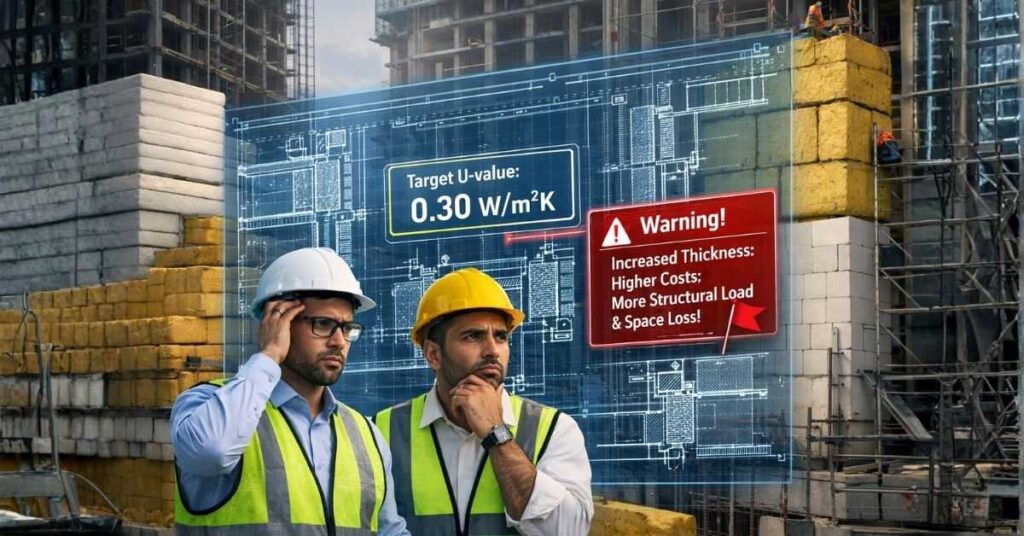
Every engineer in the UAE eventually faces these questions:
- How do we meet 0.30 W/m²K without making the wall 250mm+?
- How do we insulate block walls without losing internal area?
- How do we achieve low U-Values in high-rise projects with very limited space?
With traditional materials, the reality is harsh:
Typical Thickness Required (Traditional Insulation)
To reach U-Value 0.30–0.32, you usually need:
- 80–120 mm XPS
- 150–180 mm Rockwool
- 200+ mm AAC block
- Very thick multilayer wall systems
This results in:
❌ Loss of usable area
❌ Higher construction cost
❌ Structural load
❌ Architectural limitations
❌ Façade redesigns & delays
This is why most U-Value discussions turn into “how do we reduce thickness?”
U-Value Requirements in the UAE by Building Type
1. Residential Buildings
Must meet some of the strictest limits due to continuous occupancy.
2. Commercial Buildings
Often stricter on façades and roofs due to glass ratios and heat gain.
3. Hospitals, Schools, Hotels
Require highly efficient envelopes.
4. Industrial Buildings
Minimum compliance still required depending on conditioning.
Meeting U-Value Requirements in the UAE: Best Material Options
Below is a performance comparison (useful for consultants and architects):
| Material | Thermal Conductivity (W/m·K) | Typical Thickness for 0.30 U-Value |
|---|---|---|
| XPS | 0.034 | 100–120 mm |
| Rockwool | 0.038 | 120–150 mm |
| AAC Block | 0.16 | 200–250 mm |
| PU Foam | 0.025 | 60–80 mm |
| Spray Foam | 0.023 | 50–70 mm |
| Nano-insulation I-GK2 | 0.003 | 2–25 mm |
(The last category is introduced because many engineers look for extremely low conductivity solutions when facing wall thickness limitations.)
U-Value Requirements and The Challenges
UAE engineers repeatedly highlight these issues:
1. Wall thickness limitations
High-rise projects and tight plots cannot expand wall thickness.
2. Architectural design doesn’t allow traditional insulation
Curves, complex geometry, or façade depth restrictions.
3. Energy modeling failures
Projects fail compliance when multiple envelope elements fall slightly short.
4. Delays in approvals
Additional simulations and redesigns cause significant project delays.
5. Coordination issues
Architectural + structural + MEP often struggle to fit insulation layers within depth.
How Engineers Typically Solve U-Value Challenges
Here are the strategies used in real UAE projects:
1. Increasing insulation thickness
Most common, but reduces internal area.
2. Changing insulation material
Switch from rockwool/XPS to PU foam or higher-performance options.
3. Improving wall assembly
Adding reflective layers, cavity walls, or multiple insulation layers.
4. Using advanced thermal coatings or nano-insulation
Used when projects cannot afford thick layers.
Conclusion
Meeting U-value requirements in the UAE is not just a mandatory checkbox anymore. It directly impacts building performance, usable space, façade design freedom, and how efficiently the building runs for decades. As codes become stricter and project limitations increase, relying solely on traditional insulation methods often forces compromises between thickness, detailing, and overall performance.
That’s why the focus is shifting to high-performance, low-thickness insulation approaches. These approaches help designers and engineers meet requirements without redesigning wall assemblies or sacrificing floor area. Technologies like advanced nano-technology insulation coatings (such as I-GK2) are being explored in this context. I-GK2 is not meant to replace good design but serves as a tool that expands what’s technically possible when space, weight, or build-up limits are non-negotiable.
Understanding U-values in depth, as well as knowing the available options to control them, gives project teams more flexibility. That means fewer last-minute revisions and better outcomes. And in a market like the UAE, that flexibility often makes the real difference between a compliant design and the one that actually works.
